
THE YOUNG LAKERS
How a failed Lakers rebuild populated the rest of the league.
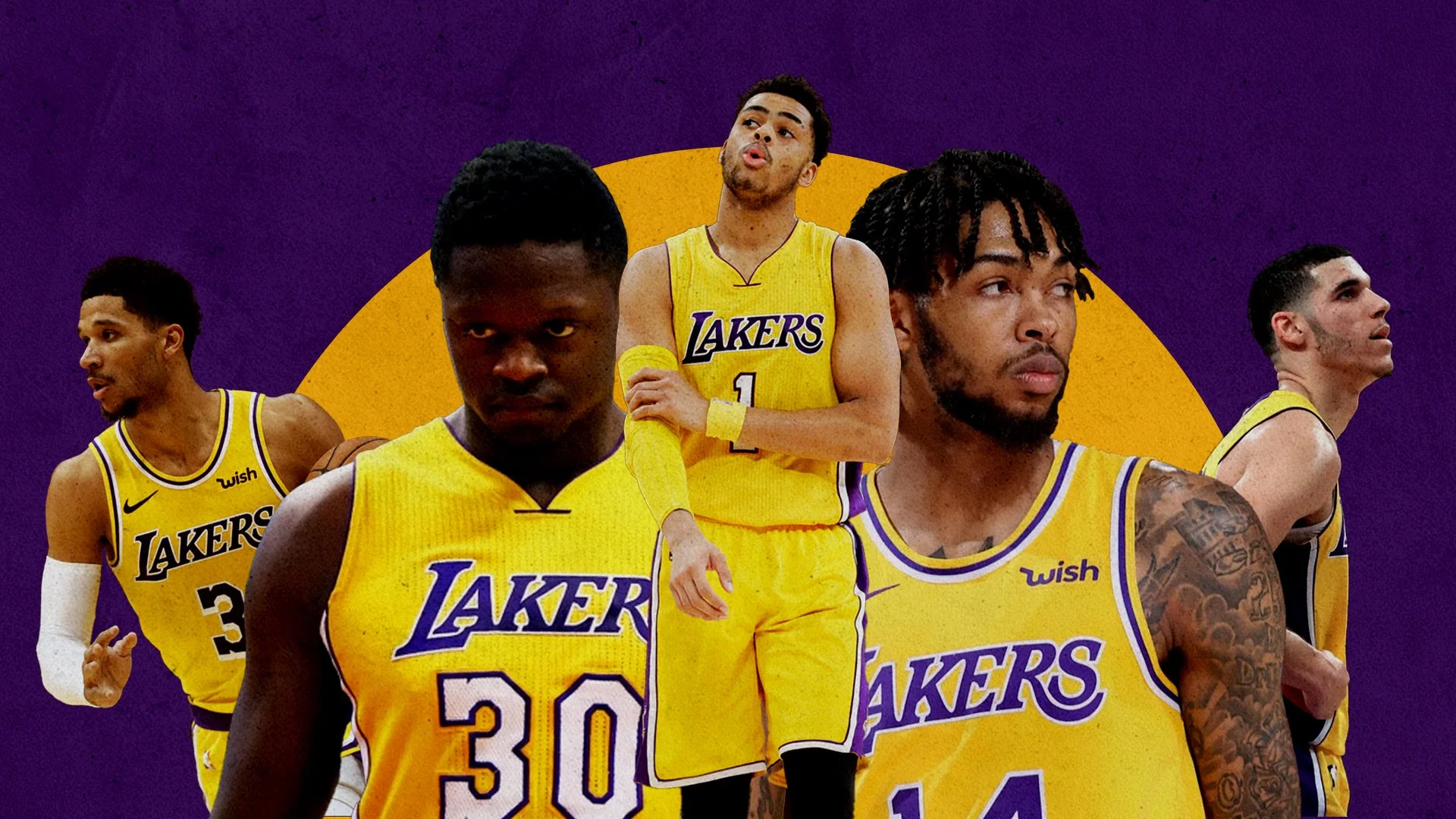
I do not care about the Los Angeles Lakers. I don’t dislike them. I’m not from Boston or the home of a Western Conference rival. I don’t root for the Lakers to lose, I simply don’t care if they win. This ambivalence extends to all of the off-court chatter that surrounds the league’s preeminent franchise. Are the Buss siblings sniping at each other in the media? Do the Lakers superstars get along? Do their fans want to trade their roleplayers for even more superstars? The answers to these questions don’t matter to me in the slightest. My stubborn disinterest stems in no small part from the world’s insistence that I think about the Lakers constantly if I am to think of basketball at all. Panel shows and podcasts all gravitate to the subject of Los Angeles like film school graduates. I’m not saying that they are wrong to do so, to be clear. The Lakers have won a substantial percentage of the available championships in NBA history. They’ve employed two of the three greatest players of all time and 9-10 of a conceivable top 20 list, depending on how the rest of Luka Doncic’s career goes. Their home games attract stars of all stripes, thanks to their proximity to the beating heart of the United States’ entertainment industry. And from a dispassionate outsider’s point of view I can concede that the Lakers have had plenty of interesting subplots this season. No other team has ever fielded a father-son duo, let alone one where the father remains a high impact player into his 40s. Their ups and downs in the standings have been engaging all year, and their current success in the playoffs suggests that their best is yet to come if they can manage to get healthy. It would be foolish for the NBA media to not talk about the Lakers all the time. But that doesn’t mean I have to care.
I suspect that readers of Indie Basketball might be able to relate to this attitude, if not about basketball than surely about music. To care about indie music, whether that means literally independent music or the more nebulous aesthetic category, requires you to scroll past music’s biggest names in search of something a little more bespoke. Maybe you don’t actively despise popular music, but your eyes might glaze over when you’re asked to care about it at the expense of the artists that get fewer headlines but rack up plays on your personal mixes. You’re right to do so. Paying attention to the lesser names has given you a richer appreciation of music as a whole. If you’ve spent any serious amount of time engaging with your local scene or underground music at large, you’ll have seen a more representative slice of music culture–its miracles and tragedies, the unsung heroes that make the former happen and suffer from the latter–than if you’d only focused on the headliners. The same is true of basketball.
There is one exception to my Lakers apathy. I found myself briefly obsessed with the Lakers from 2016 to 2019, the years in my lifetime when they were the least like themselves. This period dates from Kobe Bryant’s retirement to the trade for Anthony Davis that solidified the LeBron James version of the team as a superpower. For a team as blessed as the Lakers these four years were an existential crisis in slow motion. Unable to sign even sauceless second tier stars like LaMarcus Aldridge and lacking the front office wherewithal to trade for quality players, the Lakers had to do the unthinkable: grow organically. The mighty Lakers, forced to behave like a small market. I can’t deny that part of my fascination came from smug schadenfreude. But I doubt I’d have endured a full presidential term of bad basketball if the players on the court hadn’t been interesting in their own right. I’ve remained fascinated with these young Lakers, the ones doomed to play in the shadow of two all timers, even as they’ve scattered across the league in the ensuing years. In fact, tracking their strange journeys has enriched my experience of the NBA on a day to day basis more than following the big names.
Let’s meet this cast of ragtag would-be stars and plucky roleplayers. In no particular order…
BRANDON INGRAM
Drafted 2nd overall in 2016, mere months after Kobe’s final game. He earned a Most Improved Player award and made two subsequent appearances in the All-Star Game, though none of this happened while he wore purple and gold. By appearances Ingram resembles a star, by which I mean that his lanky silhouette and shot diet loosely resemble a poor man’s Kevin Durant. Despite the surface similarities, Ingram has never achieved Durant’s ruthless efficiency or his sneaky defensive savvy. Ingram’s failure to blossom into a top shelf scorer by the time LeBron James arrived in Tinseltown doomed him to the trade block. It was only after he was shipped off to the Pelicans as a part of the Anthony Davis trade that Ingram self-actualized. During his time in NOLA, Ingram scored a lot of points, got a lot of tattoos, and led a spirited first round battle against the Phoenix Suns. Had Ingram and his Pelicans co-star Zion Williamson enjoyed good health at the same time, maybe he could have had a real run. Instead he was traded again, this time to Toronto. Ingram’s back in the playoffs this year as the Raptors’ designated clutch shooter alongside the defensively oriented Scottie Barnes. He may not have been Durant 2.0, but he’s had a fine career and seems content.
JOSH HART
A graduate from the Chuck Person Academy of Nominal Determinism, Josh Hart might be the best overall player from this era of the Lakers. This isn’t to say that Hart is a star. He’s not the kind of player that will sell a lot of shoes, but he will do everything else you need to win a basketball game. A consummate roleplayer, Hart's game is all hustle, muscle, and well, heart. He dives for loose balls. He collects a freakish amount of rebounds for a player his size. He’ll guard anyone. He’ll hit some threes. He makes his teammates laugh and every fanbase that gets a chance to root for him inevitably falls in love. Hart was also sent to New Orleans in the Anthony Davis trade, played a brief stint in Portland, and eventually found his way to New York to join his fellow Villanova alumni on the Knicks. He could have easily fit into the Lakers title team, but players this useful and low maintenance don’t get to choose their destiny. Love this guy.
JULIUS RANDLE
The elder statesmen of this cohort. Randle spent his rookie season recovering from a gnarly leg injury, returned into the media circus of Kobe’s retirement tour and never quite found his footing on the roster as even younger prospects joined the roster. Like Hart, Randle first went to New Orleans and then New York, though he made those moves as a free agent. Like Ingram, Randle reinvented himself as a multitime all star and earned a MIP along the way. In the years before Jalen Brunson arrived, Randle made for awkward leading man on a Knicks team clawing its way back to normalcy after a decade plus of nonsense that puts the Lakers brief tour in the NBA slums to shame. Randle was what the Knicks needed, but not what the fans wanted. Part of this came from his surly attitude–going so far as to give the crowd a thumbs down during a particularly bad stretch–and the rest stemmed from his unorthodox style on the court. Few players can boast Randle’s mix of bullyball scoring, sharp playmaking, and battering ram frame. On the other hand, the guy always plays like he just stepped out of a Tilt-A-Whirl. The Knicks traded him for another lumbering, divisive center and he’s made a fine second banana to Anthony Edwards on the Timberwolves. Still, I can’t shake the feeling that things would have gone better for Randle had he not started his career on the wrong foot.
LONZO BALL
The chosen one, and the player suffering from the most severe “what could have been”-itis of this whole bunch. Lonzo Ball entered the NBA with heavy expectations weighing on both shoulders. The Lakers hoped Ball would be their next homegrown superstar, hailing from Southern Cali no less! Magic Johnson, acting as the team’s general manager, told Ball that he expected his jersey to hang in the rafters one day. On his other shoulder Ball felt pressure from his father LaVar, an all time American carnival barker who hoped that his three sons would launch a successful shoe brand and change the face of basketball forever. All of this put a giant target on Ball’s back. He spent his rookie season getting bullied by the league’s veteran guards and scrutinized by the media. All of this hoopla made it easy to overlook how talented Ball was as a defender and passer. Once his much hyped outside shooting finally came together Ball was one of the most exciting young guards in the league. I speak in the past tense because after suffering a series of nasty injuries as a Pelican and then again as a Bull, it appears that Ball is well and truly washed. His younger brother on the other hand…
D’ANGELO RUSSEL
Lonzo Ball’s saga is a tragedy, D’Angelo Russell’s is a farce. Russell had the pedigree of a second overall draft pick, a flashy style and an ice cold celebration, but always came across as a little unserious. Russell goofed himself off the team by filming teammate Nick Young’s admission to cheating on Iggy Azalea and posting the footage to social media. For that boneheaded breach of locker room bro-code, Russell was banished to the Nets. Brooklyn was good for him. Given the keys to a rebuilding team and guidance from coach Kenny Atkinson, Russell even snuck onto an All Star team. Once the Nets had earned enough clout to attract Kevin Durant and Kyrie Irving Russell was jettisoned back west. Since then Russell has spent the 2020s bouncing around the league, even returning to the Lakers, with diminishing returns at each stop. Apparently he’s on the Wizards now? I totally missed that.
There are others of course. Ivica Zubac, who barely saw the court until he was traded to the Clippers. Larry Nance Jr. and Jordan Clarkson, both traded to the Cavs to help LeBron challenge the Warriors one last time and to clear the cap space for LeBron to sign with the Lakers. Kyle Kuzma, whose airhead hypebeast persona was a perfect fit for the Laker fanbase and whose trade for Russell Westbrook proved to be the death knell to the LeBron/AD era’s title window. And of course there’s Alex Caruso, who held on to win a chip with the Lakers in 2020 and has gone on to be a crucial part of the Thunder’s swarming defense, winning another chip in the process. Caruso might mess around and become this generation’s Robert Horry at this rate.
These wayward Young Lakers remind me of the way musicians from a local scene will scatter to the winds after a few years. Some go on to bigger cities and better things, others flame out, while the rest settle into a niche and make a home of it. Turning on a random NBA game and seeing Brandon Ingram facing off against Jordan Clarkson in Utah gives me the same warm and fuzzy feeling of seeing the bassist of a band I’d caught in a small club hit the stage at Red Rocks. That isn’t a hypothetical by the way. I’m referring to bassist Michael Byrnes, who I’d seen play in the highly underrated Chicago pop rock band Coaster and now plays in Mt. Joy who are legit huge. It’s the same rush I get seeing Jon Samuels, who I met while he was touring with Yowler, ripping leads next to MJ Lendermen. It goes further than just the musicians filling out the rosters of successful bands. I’ve seen door guys go to run venues years later. Engineers that used to mix out of their bedroom now have jobs at real deal studios. Publicists have bounced from agency to agency, some of them splintering off to form their own boutiques. The music industry is littered with these subtle interconnections. Yes, the NBA is a star driven league, as is the music industry. But the gears, the rubber on the tires, the pistons and the Pistons, are made up of roleplayers, journeymen, and session players. Without them the game would go nowhere.