
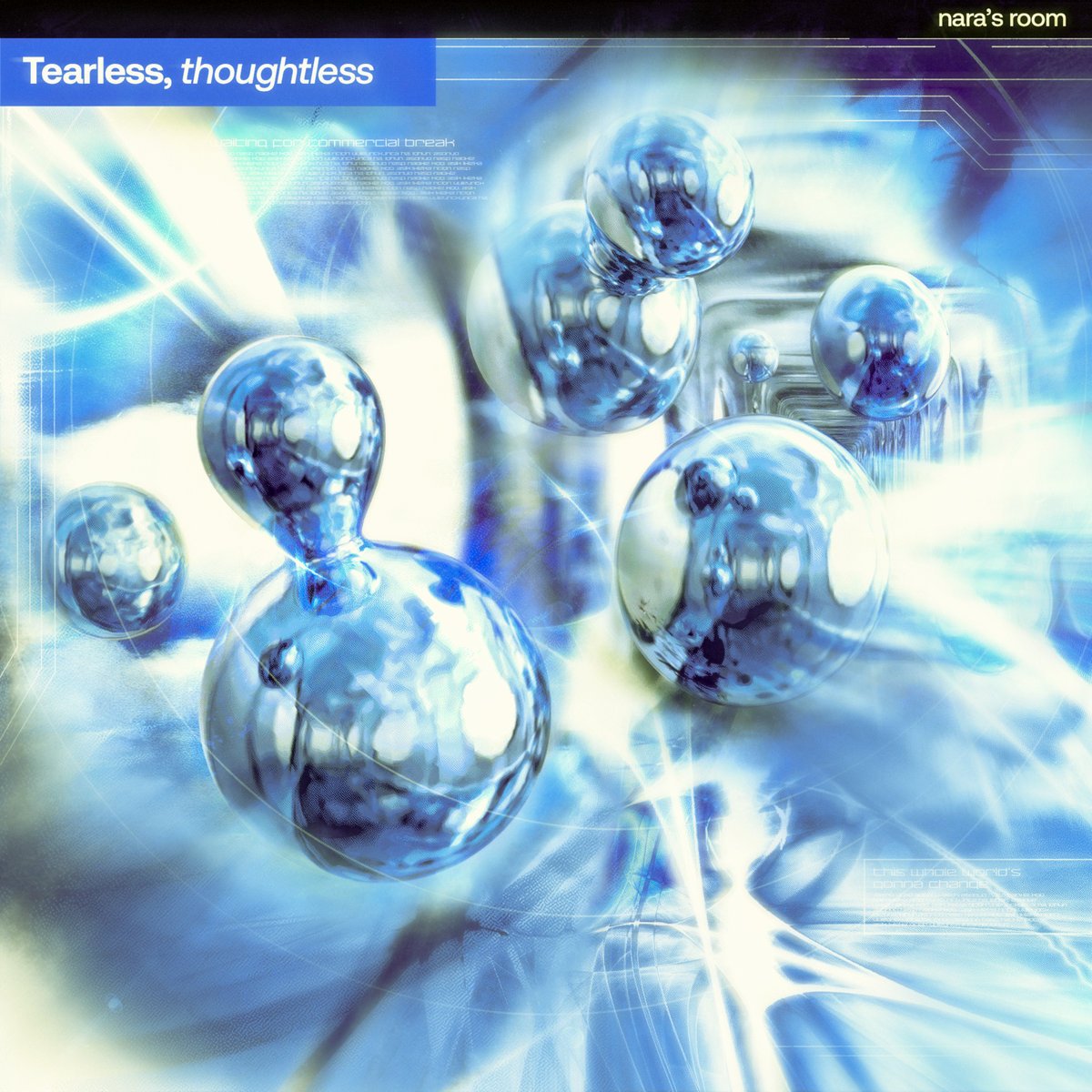
Nara’s Room - Tearless, thoughtless
2026 • MTN LAUREL RECORDING CO. • DIGITAL SHOEGAZE / AMBIENT PUNK
80/100
For Nara Avakian (they/them), music is a form of archival permanence. It is a deliberate stand against the high-definition circus of the present. Tearless, thoughtless reaches back to the tactile safety of the Y2K era to anchor a sound that is both private and fragile.
The production is thick with digital hum and an ambient wanderlust. It’s a record of deep bass drives that collide with a vocal that periodically dissolves into a multiplying siren. This is digital shoegaze: ambient flowers among fuzz guitar grass and the wry, neon glow of the keys. It uses shoegaze’s signature wall of sound to emote, but layers a 420p digital depth over the noise. It feels like a hug from inside a boxy gray television, refining a hardware breakdown into sanctuary.
The album operates on a spectrum between two distinct anchors: the Saturday-morning escapism of "Lizzie McGuire" and the heavy, ancestral weight of "Tucson."
"Lizzie McGuire" is the record’s unexpected sugar rush. It captures a specific "Saturday freedom" vibe rooted in the physical tension of waiting for a commercial break—the vibrating stillness of a kid refusing to move until the screen finally cuts to black. To capture that thrift-store nostalgia, the band (Ethan Nash, Brendan Jones, and Will Fisher) re-amped the guitar hook through a cheap karaoke amplifier. This aged the sound to mimic the blown-out speakers of an old car. Underneath the fuzz, Avakian weaves a constantly noodling, Armenian-inflected guitar line that hangs over the track's digital chaos like a set of digital icicles. For Avakian, these media artifacts aren't just kitsch; they were sanctuaries used to cope with a childhood marked by fear and abuse.
If "Lizzie McGuire" is the wonderment viewed through past comforts, "Tucson" is a heavy settling of accounts. A transportive seven-minute centerpiece, the song carries the inertia of a late-night drive. It draws a direct line to Linda Ronstadt, using the loss of her singing voice as a visceral metaphor for a people forced into silence. When Avakian sings, "I’ll wait for the fire to come / To take back what was mine," it is the sound of a stolen voice being reclaimed.
As a descendant of Armenian Genocide survivors, Avakian treats music as a form of archival permanence. In a world where architecture and antiquity are bulldozed for boxes and banality, this record is a deliberate act of cultural preservation. It is a grounded, steady stand, against erasure to ensure that their voice and history cannot be drowned out.
NBA COMP: JOSE ALVARADO
Nara’s Room is the "Grand Theft Alvarado" of the Brooklyn scene. Like Jose Alvarado, the music is undersized compared to the massive industry giants, yet it thrives on being a "glitch in the system." Just as Alvarado uses his height as a tactical advantage to disappear and then strike, Nara’s Room uses lo-fi aesthetics and "trash" media as armor. It turns technical weaknesses into a high-impact defensive shell.